
 By Niamh Gallagher · Last updated November 2026
There’s no sound in sport quite like the Cheltenham roar as the field sets off in the first race on the Tuesday. Half of it, or so it feels, comes from Irish throats.
For four days every March, Prestbury Park becomes a home from home for Irish racing fans, and the betting goes into overdrive. This guide covers how Cheltenham betting works, the championship races, the concessions worth knowing about, and how I’d approach the week without running out of money by Wednesday.
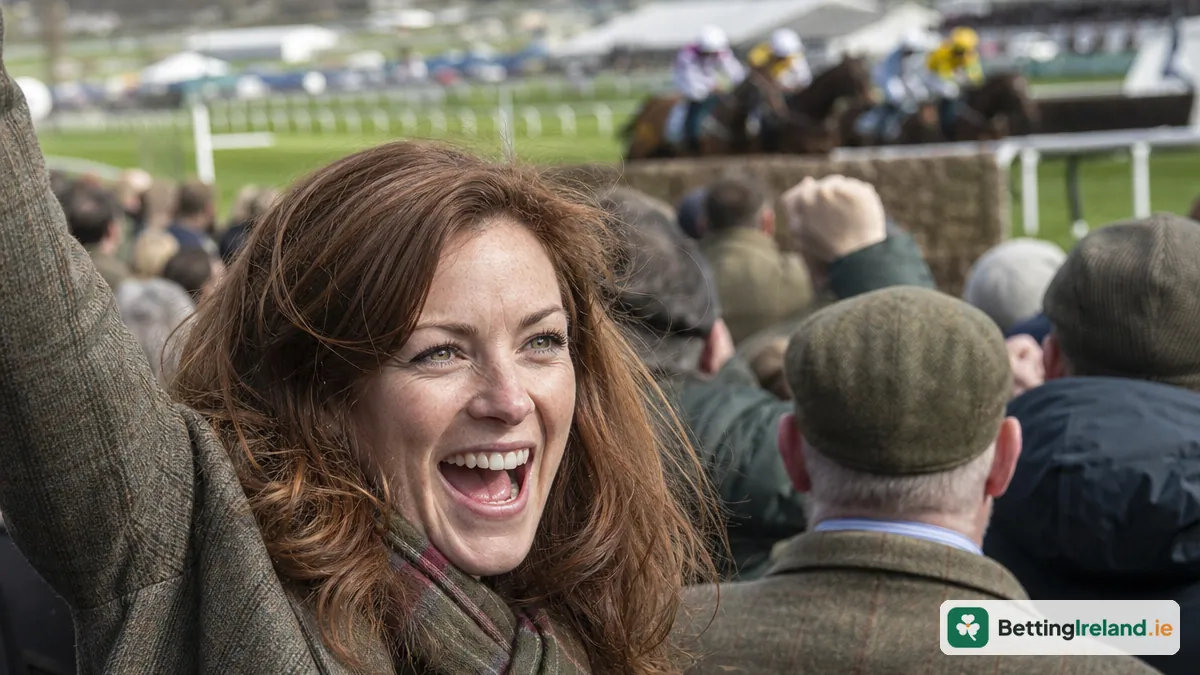
The Irish Raid on Prestbury Park
The Cheltenham Festival is the high point of the National Hunt season in Britain and Ireland: four days of top-class jump racing, with a championship race at the heart of each day.
For Irish punters, it’s personal. The Irish raiders travel over in numbers every year, and in recent seasons Irish-trained horses have dominated, with the big yards of trainers like Willie Mullins and Gordon Elliott sending strong teams across. There’s a friendly rivalry with the British trainers, and the Prestbury Cup keeps score between the two countries across the week.
That means a lot of the best Cheltenham form is made at home. The Christmas meeting at Leopardstown and the Dublin Racing Festival there in February are two of the most important trials. If you’ve followed Irish racing through the winter, you already know more about many of the runners than the headline odds might suggest.
Four Days, Four Championships
Each day builds towards one headline race, with novice championships, the cross-country and a run of big-field handicaps around it.
Tuesday: the Champion Hurdle and the opening roar
The opening day builds to the Champion Hurdle, the top race for hurdlers over two miles. It’s speed and slick jumping at full tilt, and one mistake at a flight can end a horse’s chance. It’s usually the first big betting race of the week.
Wednesday and Thursday: two miles of fences, then a test of stamina
Wednesday’s centrepiece is the Queen Mother Champion Chase, a two-mile race for the fastest chasers, where accurate jumping at speed is everything. Thursday has the Stayers’ Hurdle for the hurdlers who go further, a race that rewards horses who can keep galloping when others are tiring. Both are championship races in their own right, and both draw serious Irish interest.
Friday: Gold Cup day
Friday is Gold Cup day, the race every jumps trainer wants to win. It’s run over more than three miles of fences on Cheltenham’s demanding track, including the stiff uphill finish, so stamina and jumping both get a proper examination. It’s the most prestigious steeplechase of the season.
Ante-Post or On the Day: When to Strike at Cheltenham
This is the biggest decision in Cheltenham festival betting, and there’s no single right answer. Ante-post markets on the big races are open months before the festival, while on-the-day prices only settle once the final fields and the going are known. Which suits you depends on how closely you follow the form through the winter and how much risk you’re happy to carry.
The case for ante-post
Ante-post means betting well before the race, sometimes months out. The appeal is price. A horse who’s 10/1 in November might be 3/1 by March if it keeps winning. €10 at 10/1 returns €110 if it wins; the same €10 at 3/1 on the day returns €40.
The risk is that if your horse doesn’t run, a standard ante-post bet is usually lost. Horses get injured, trainers change plans, and a horse can be switched to a different race at the last minute. You’re also taking a price with no idea of the ground.
The case for waiting
Betting on the day gives you certainty. You know the horse is running, you know the going, and you know the final field. The trade-off is that the obvious horses will be shorter than they were months ago. Ante-post suits punters who follow the form all winter and are happy to carry a few losers. On the day suits almost everyone else.
Extra Places in the Big Handicaps
Cheltenham fields are big and competitive, which makes each-way betting very appealing. Under the standard terms, a non-handicap with eight or more runners pays three places at 1/5 odds, and a handicap with 16 or more pays four places at 1/4.
Bookies compete hard for festival business, so you’ll often see extra places on the big handicaps. Here’s how that can change a €5 each-way bet (€10 total) on a 16/1 shot:
| Place terms | Place odds | Return if 4th | Return if 5th |
|---|---|---|---|
| 4 places, 1/4 odds | 4/1 | €25 | €0 |
| 5 places, 1/4 odds | 4/1 | €25 | €25 |
| 6 places, 1/5 odds | 16/5 | €21 | €21 |
That extra place can be the difference between a losing race and a small profit. The fraction matters too: more places at 1/5 can be worth less than fewer places at 1/4 if your horse finishes in the first four.
BOG and Non-Runner No Bet: The Two Concessions That Matter in March
Best Odds Guaranteed (BOG) means that if you take a price and the starting price is bigger, you’re paid at the bigger price. Take 6/1 on the morning of the Champion Hurdle, see it go off 8/1, and a €10 winner returns €90 instead of €70. It’s especially valuable at the festival, where prices can move a lot in the hours before a race.
Non-Runner No Bet (NRNB) means that if your horse doesn’t run in the race, you get your stake back. It’s the safety net that makes ante-post betting far less painful. Bookies usually switch their ante-post markets to NRNB in the weeks leading up to the festival, but the timing differs.
The key point is that bookies’ concessions vary. Not every bookie offers BOG, extra places differ race by race, and NRNB start dates aren’t the same everywhere. Those three things are top of my list when I’m weighing up bookies for the festival, and you can see how the five I rate compare on my bookmakers Ireland page. 18+. T&Cs apply.
Habits I’d Stand Over for the Four Days
I’m not going to give you horses here, because by the time you read this the picture will have changed. These are the habits I stick to.
- Follow the Irish trials. Leopardstown at Christmas and the Dublin Racing Festival tell you a huge amount. Watch the replays, not just the results.
- Wait for NRNB before going ante-post. Unless you’ve a strong view early, those extra weeks of protection are usually worth more than a slightly bigger price.
- Respect the ground. Cheltenham in March can be anything from soft to good, and some horses only show their best on one or the other.
- Go each-way in the handicaps. Big fields and extra places are made for it, and favourites in those races get beaten all the time.
- Set a budget for the week, not the day. If you blow it all on Tuesday, Gold Cup day will be a quiet one.
- Don’t chase. Some days the favourites all win, some days they all lose. Stick to your stakes either way.
FAQ
When is the Cheltenham Festival?
It runs over four days in March at Prestbury Park in Cheltenham, England, with the Champion Hurdle on the Tuesday and the Gold Cup on the Friday.
What does Non-Runner No Bet mean?
If your horse doesn’t take part in the race, your stake is refunded. Bookies usually introduce it on ante-post markets in the run-up to the festival.
Is it better to bet ante-post or on the day?
Ante-post can get you bigger prices but carries the risk of your horse not running. On the day is safer, but the prices are usually shorter.
Do bookies offer extra places at Cheltenham?
Many do on the big handicaps, but the number of places and the terms vary from bookie to bookie and race to race.
Cheltenham is meant to be the craic, so keep it that way. If betting is getting on top of you, visit gamblingcare.ie or ring Gambling Care on freephone 1800 753 753.